
AI agents are not a strategy by themselves. They are workers inside a system. The design work starts with the workflow: what must be observed, retrieved, reasoned through, drafted, or acted on — and what controls must exist before the system touches real business data or tools.
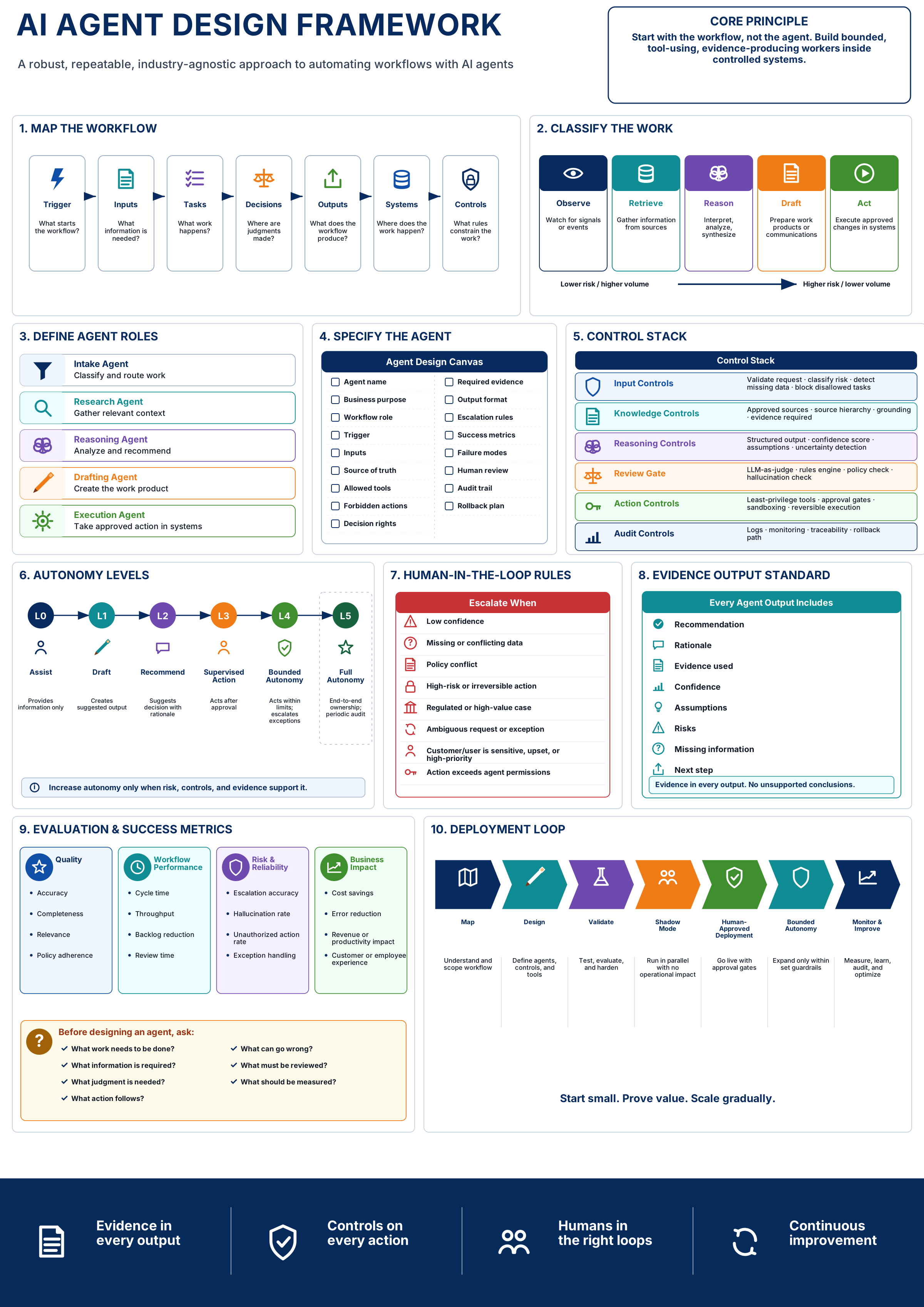
Start with the workflow.
The first artifact is not a prompt. It is a workflow map: trigger, inputs, tasks, decision points, outputs, systems, and controls. If the current process is not legible, the agent will inherit that ambiguity and make it faster.
For each workflow, we separate the work into five categories: observe, retrieve, reason, draft, and act. The risk changes as you move across that sequence. Watching for a signal is not the same as sending a customer message, changing a record, or approving a payment.
Define the worker before giving it tools.
An agent needs a job description before it needs access. We define its business purpose, allowed inputs, source of truth, permitted tools, forbidden actions, decision rights, output format, review rules, failure modes, audit trail, and rollback plan.
That prevents the common failure mode: a general assistant with vague authority and too much context. Production agents should be boringly specific. Intake agents classify and route. Research agents gather context. Reasoning agents analyze and recommend. Drafting agents prepare work products. Execution agents act only inside approved boundaries.
Controls are part of the product.
A governed agent system needs controls at every layer: request validation, approved knowledge sources, structured reasoning, review gates, least-privilege tool access, and traceable logs. These are not enterprise theater. They are what make the output reviewable and what make the system safe enough to run near real workflows.
The control question is simple: what would need to be true for this worker to do more next month than it is allowed to do today? If the answer is not measurable — better eval results, lower exception rate, cleaner audit trail, clearer escalation behavior — the autonomy level does not increase.
Humans stay in the right loops.
Human-in-the-loop does not mean a person approves every token. It means people review the work where judgment, risk, ambiguity, or authority matters. Escalation rules should be written before launch: low confidence, missing or conflicting data, policy conflict, high-value cases, upset customers, irreversible actions, or anything outside the agent's permission boundary.
The target is not maximum autonomy. The target is the highest safe level of autonomy for that workflow today.
Every output needs evidence.
A useful agent output should include the recommendation, rationale, evidence used, confidence, assumptions, risks, missing information, and next step. Without that structure, reviewers are stuck deciding whether the prose sounds right. With it, they can inspect the actual basis for the recommendation.
Confidence is not a truth score. It is one signal alongside source quality, policy checks, eval history, and the risk of the next action.
Deploy in loops, not big-bang launches.
The deployment path is staged: map, design, validate, shadow mode, human-approved deployment, bounded autonomy, then monitor and improve. Shadow mode is where many bad ideas should die. It lets the agent run beside the current workflow with no operational impact while the team measures accuracy, cycle time, exception handling, and review burden.
Only after the system beats the baseline on the metrics that matter should it move into the workflow. Even then, the first version should act within narrow limits and escalate exceptions.
How Aiveris uses this.
We use this framework before building agent systems for clients. It keeps the conversation grounded in the workflow, not in model hype. It also makes the implementation plan clearer: what to automate, what to leave human-owned, what evidence to log, what tools to expose, what controls to add, and how the pilot will be judged.
If your team is considering an agent, bring one workflow. We will help separate the parts a model can safely handle from the parts that need tools, controls, review, or a different design entirely.